AI agent assist is transforming contact centers from cost centers into strategic, customer-obsessed powerhouses. Instead of replacing human agents, modern 에이전트 지원 고객센터 solutions work alongside them, providing real-time guidance, information, and automation during every interaction. By leveraging AI-powered call center loyalty tactics, businesses can enhance customer retention while ensuring faster resolution, higher satisfaction, and happier, more confident agents.
In today’s rapidly evolving landscape, building a successful agent assist contact center requires combining advanced tools with strategic insights. Many organizations are now exploring how emerging technology platforms streamline complex workflows for modern enterprises to provide agents with instant access to critical customer data. Similarly, understanding cutting-edge high-performance computing and data management solutions for real-time operations helps contact centers handle large volumes of interactions efficiently while predicting customer needs before they arise.
Integrating these technologies with intelligent marketing strategies further enhances the customer experience. Businesses that apply long-term online marketing strategies to improve customer engagement and retention can ensure that agent recommendations are aligned with promotional campaigns, improving the relevance of offers and reducing service friction. In addition, exploring comprehensive approaches for digital marketing optimization across multiple online channels helps contact centers leverage AI-driven insights for smarter, more personalized customer interactions.
For financial institutions, combining AI agent assist with actionable insights is critical. By using advanced financial guidance and planning tools for customer-facing representatives, agents can provide precise, tailored advice in real-time, building trust and encouraging loyalty. The synergy of intelligent automation, predictive analytics, and effective marketing ensures that an agent assist contact center is not just a support function but a strategic driver for long-term customer satisfaction and business growth.
Top 10 Agent Assist Contact Center Solutions for Modern Businesses
Choosing the right platform for your agent assist contact center can significantly impact customer satisfaction, agent productivity, and operational efficiency. Here’s a list of top solutions that help businesses leverage AI, automation, and intelligent guidance to improve every customer interaction.
1. Bright Pattern
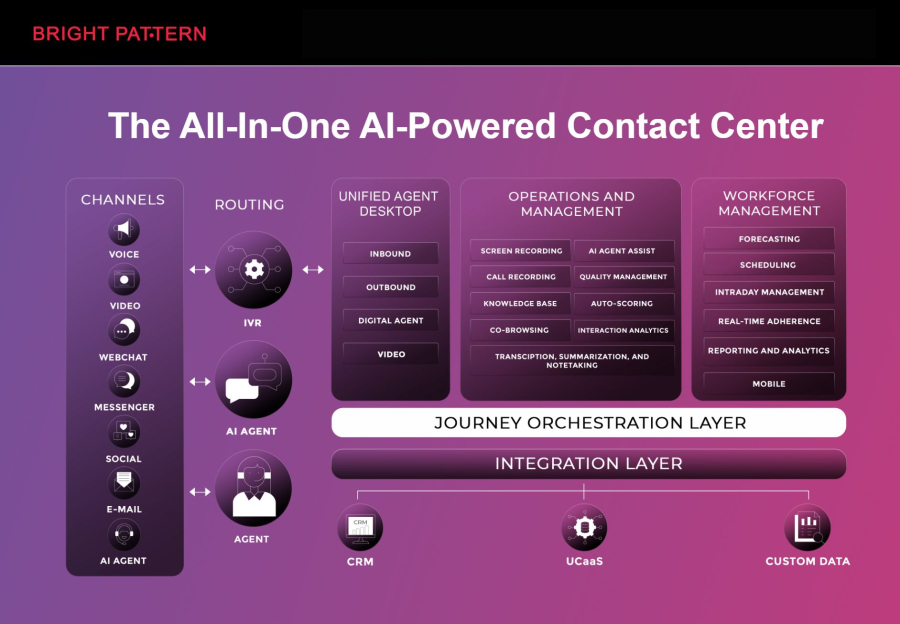
Bright Pattern is a leading platform for agent assist contact centers, designed to help agents resolve customer issues faster while maintaining a personal touch. Its AI-powered capabilities provide real-time suggestions, automate routine tasks, and ensure consistency across all channels. Bright Pattern is ideal for businesses looking to boost agent performance and enhance customer loyalty.
Key features of Bright Pattern include:
- AI-driven real-time agent guidance
- Seamless omnichannel support (voice, chat, email, SMS, social)
- Automated workflow and case management
- Integration with CRM and third-party applications
- Advanced analytics for performance optimization
With Bright Pattern, contact centers can turn data into actionable insights, reduce average handling times, and empower agents to deliver exceptional experiences consistently.
2. Genesys Cloud
Genesys Cloud offers AI-enabled agent assist tools that provide suggestions, automate repetitive tasks, and analyze customer interactions for insights. It is known for its scalability and flexibility in both large enterprises and growing businesses.
3. NICE inContact
NICE inContact delivers cloud contact center solutions with AI-powered agent assist features. Agents benefit from real-time guidance, predictive analytics, and automated workflows to improve efficiency and customer satisfaction.
4. Five9
Five9’s AI-driven platform enhances agent performance with real-time recommendations, call routing, and automation. Its cloud-based system makes it easy to manage distributed teams while keeping customer interactions smooth and consistent.
5. Talkdesk
Talkdesk provides intelligent agent assist tools that integrate AI suggestions and automation directly into the workflow. Its platform emphasizes quick onboarding, multi-channel support, and actionable analytics for contact center managers.
6. Cisco Contact Center
Cisco’s solution combines AI, automation, and robust reporting to assist agents in resolving queries efficiently. Its agent assist tools focus on providing relevant knowledge and real-time insights during customer interactions.
7. Avaya OneCloud
Avaya OneCloud includes AI-powered agent assist functionalities that help improve first-call resolution rates. Agents receive contextual guidance and workflow automation, making complex interactions easier to handle.
8. Aspect Via
Aspect Via enhances agent productivity through AI suggestions, process automation, and omnichannel integration. Its platform is suitable for both large enterprises and mid-size companies looking to modernize customer service.
9. RingCentral Contact Center
RingCentral offers an agent assist contact center solution that provides AI-driven guidance, analytics, and automation. Its easy-to-use interface supports multi-channel communication and improves agent efficiency.
10. 8x8 Contact Center
8x8 delivers a cloud contact center with AI-enabled agent assist tools. Its features include real-time prompts, workflow automation, and customer analytics, helping teams resolve queries faster and more accurately.
What Is Agent Assist in a Contact Center?
Agent assistis an AI-powered capability that supports live contact center agents in real time during calls, chats, emails, or messaging conversations. It analyzes what the customer and agent are saying or typing, then surfaces the most relevant information, next-best actions, and automations directly in the agent desktop.
Instead of agents juggling multiple systems, searching knowledge bases, and trying to remember complex policies, agent assist becomes a digital co-pilot that continuously helps them deliver better service.
Typical Agent Assist Capabilities
- Real-time transcriptionof voice calls so AI can understand context and agents can focus on listening, not note-taking.
- Suggested responsesfor chat, email, and messaging based on customer intent and company policies.
- Knowledge recommendationsthat surface the right articles, procedures, and troubleshooting steps at the exact moment they are needed.
- Next-best-action guidancethat prompts agents with what to do next, such as verifying identity, offering an upsell, or escalating.
- Automated after-call workincluding summaries, dispositions, and tagging, so agents spend more time with customers and less time on admin.
- Compliance coachingthat reminds agents of required disclosures, scripts, or regulatory steps in real time.
- Real-time sentiment and intent detectionso agents can adjust tone, show empathy, and proactively defuse frustration.
Why Agent Assist Matters Now
Customer expectations are rising, while contact centers are under pressure to handle more volume with leaner teams. At the same time, products, policies, and channels are more complex than ever.
Agent assist directly addresses these challenges by:
- Reducing the cognitive load on agents.
- Shortening the time it takes to become proficient.
- Creating greater consistency across the entire team.
- Using data from every interaction to continuously improve.
The result is a scalable, sustainable way to deliver premium customer experiences without burning out your workforce.
Key Business Benefits of Agent Assist
1. Faster Handle Times Without Sacrificing Quality
Average handle time (AHT) is one of the most monitored KPIs in any contact center. Agent assist reduces AHT by giving agents what they needinstantly, instead of forcing them to search through multiple applications or ask for help.
- Instant knowledge lookupminimizes dead air and long chat pauses.
- Pre-drafted responsesremove typing time while still allowing personalization.
- Process guidancekeeps calls moving forward with fewer backtracks and corrections.
When every second matters, even small reductions in AHT add up to major operational savings and greater capacity to handle spikes in volume.
2. Higher First Contact Resolution (FCR)
Customers hate being transferred, repeating themselves, or waiting for callbacks. Agent assist helps agents resolve more issues the first time by:
- Surfacing relevant troubleshooting steps based on the conversation.
- Highlighting the most likely root causes using historical interaction data.
- Guiding agents through complex workflows (for example, multi-step verifications or refunds).
Higher FCR directly translates into better customer satisfaction, lower follow-up volume, and less rework for the team.
3. Improved CSAT and NPS
Customers can feel the difference when an agent is confident and prepared. With agent assist, agents spend less time searching and more time connecting. That leads to:
- More natural, human conversations.
- Fewer frustrating delays and transfers.
- Faster, more accurate answers.
Real-time sentiment detection also allows agents to adjust their tone and approach on the fly. If the system flags increasing frustration, the agent can slow down, show more empathy, or escalate before the situation deteriorates. Over time, this drives up metrics like CSAT, NPS, and customer lifetime value.
4. Reduced Training and Onboarding Time
Training new contact center agents is expensive and time-consuming. In many environments, it can take months before new hires are fully productive. Agent assist shortens that learning curve by embedding guidance directly in the workflow.
- New agents can rely onon-screen promptsto walk them through calls.
- Step-by-step guidancereplaces heavy memorization.
- Real-time hintshelp them answer unfamiliar questions with confidence.
This does not just reduce training costs; it also increases new hire confidence, lowers early attrition, and allows supervisors to focus coaching on higher-value behaviors, not basic procedures.
5. Greater Consistency and Compliance
In regulated industries or complex environments, even small mistakes can create significant risk. Agent assist supports consistent, compliant conversations by:
- Prompting agents with required disclosures or legal language at the right moment.
- Monitoring language in real time and flagging potential non-compliance.
- Ensuring agents follow the correct, up-to-date process every time.
Instead of relying on memory or printed scripts, agents have a dynamic guide that updates as regulations and policies evolve.
6. Better Agent Experience and Lower Attrition
The job of a contact center agent can be stressful. They are handling high volumes, complex inquiries, and emotional customers, often while navigating dozens of systems. Agent assist lightens that load.
- Agents feelmore confidentbecause help is always available on-screen.
- Work becomesless repetitiveand more skilled, as AI handles routine tasks.
- Feedback and coaching aremore constructive, supported by interaction insights.
Happy, supported agents stay longer, perform better, and represent your brand more positively.
How Agent Assist Works Behind the Scenes
While implementations vary, most agent assist solutions share a similar foundation built on modern AI technologies.
Core Technology Components
- Speech recognitiontranscribes phone calls in real time, turning audio into text that AI can understand.
- Natural language processing (NLP)analyzes text from calls, chats, and emails to identify intent, sentiment, and key entities.
- Machine learning modelspredict next-best actions, suggest responses, and match queries to the best knowledge content.
- Integration layerconnects agent assist with CRM, ticketing, knowledge bases, and telephony systems.
- Agent UIsurfaces recommendations and guidance in a clean, intuitive interface within the agent desktop.
The power of agent assist comes from combining these capabilities in real time, so the AI is not just analyzing conversations after the fact but actively helping while they happen.
Typical Agent Assist Workflow in a Call
- The call begins and audio is transcribed live.
- NLP analyzes the conversation, detecting the customer issue and sentiment.
- The system searches knowledge and past interactions to suggest answers and next steps.
- The agent sees recommended prompts, responses, and actions on-screen and chooses how to use them.
- As the conversation evolves, recommendations update dynamically.
- After the call, AI generates a summary, tags, and disposition notes, which the agent can quickly review and confirm.
Throughout the interaction, the human agent remains in control. AI augments their abilities; it does not override their judgment.
Agent Assist Use Cases Across Channels
Voice Calls
On voice channels, agent assist focuses on transcription, knowledge surfacing, and real-time coaching. Benefits include:
- Less time on hold while agents search for answers.
- Improved active listening, since agents do not need to type detailed notes.
- More accurate call summaries and follow-up actions.
Chat and Messaging
In digital channels, speed and accuracy matter even more. Agent assist can:
- Recommendpre-written responsestailored to the customer and context.
- Adjust tone to match your brand voice and the customer situation.
- Help agents handle multiple simultaneous chats without sacrificing quality.
Email and Back-Office Work
Agent assist also supports email and case work by:
- Summarizing long email threads.
- Suggesting structured responses and next steps.
- Extracting key details and automatically populating forms or case fields.
Measuring the Impact of Agent Assist
To fully capture the value of agent assist in a contact center, it helps to track both operational and experience metrics.
Key Performance Indicators (KPIs)
|
Metric |
How Agent Assist Helps |
|
Average Handle Time (AHT) |
Reduces search time, streamlines workflows, and automates after-call work. |
|
First Contact Resolution (FCR) |
Guides agents to the right answers and processes on the first interaction. |
|
Customer Satisfaction (CSAT) |
Improves speed, accuracy, and empathy in each conversation. |
|
Net Promoter Score (NPS) |
Creates more consistent, high-quality experiences that build loyalty. |
|
Agent Productivity |
Enables agents to handle more interactions with less effort. |
|
Agent Retention |
Reduces stress and improves job satisfaction with better support. |
|
Quality and Compliance Scores |
Provides real-time coaching to avoid errors and missed steps. |
Designing a Successful Agent Assist Program
Deploying agent assist is not just a technology project; it is a change in how your contact center operates. A thoughtful approach maximizes value and drives adoption.
1. Clarify Your Objectives
Start by defining what success looks like. Common objectives include:
- Reducing AHT without harming CSAT.
- Improving CSAT or NPS for specific contact types.
- Shortening new hire ramp-up time.
- Standardizing compliance-critical interactions.
Clear goals will guide which use cases you prioritize and how you measure results.
2. Prioritize High-Impact Use Cases
Not every interaction needs the same level of assistance. Focus first on areas where AI support will deliver the greatest value, such as:
- High-volume call types where small time savings add up fast.
- Complex, error-prone processes that create compliance risk.
- Segments with lower CSAT or FCR where guidance can raise performance.
3. Engage Agents Early and Often
Agent buy-in is essential. Frame agent assist as a tool that empowers them, not a system that monitors or replaces them. Involve agents by:
- Inviting feedback during pilot phases.
- Highlighting how AI reduces busywork and stress.
- Recognizing and rewarding agents who embrace the new tools.
When agents see tangible benefits in their day-to-day work, adoption accelerates naturally.
4. Integrate with Existing Systems
Agent assist is most effective when it is deeply integrated into your existing contact center environment. Consider connections with:
- CRM and customer databases for context-aware recommendations.
- Ticketing and case management systems for automated updates.
- Knowledge management platforms to keep guidance current.
- Telephony and digital channels so AI can access all interaction data.
5. Iterate Based on Data
AI systems improve over time, especially when guided by real operational feedback. Monitor performance and continuously refine:
- Which prompts and suggestions are most helpful to agents.
- Where agents ignore or override recommendations.
- How KPIs shift after new features are introduced.
Use this data to adjust models, update content, and refine workflows for maximum impact.
Real-World Examples of Agent Assist Value
While results vary by organization, several patterns are emerging across industries that adopt agent assist in their contact centers.
Example 1: Telecom Contact Center
- High volume of technical support calls and plan changes.
- Agent assist used to provide troubleshooting flows and plan recommendations in real time.
- Measured outcomes commonly include lower AHT, fewer escalations, and higher customer satisfaction for technical calls.
Example 2: Financial Services Support
- Strict regulatory requirements and complex product portfolios.
- Agent assist supports agents with real-time disclosure prompts and product guidance.
- Typical benefits include improved compliance scores, reduced supervisor interventions, and more consistent customer experiences.
Example 3: E-commerce and Retail Service
- High seasonal peaks and large numbers of new agents.
- Agent assist helps new hires handle returns, order tracking, and product inquiries from day one.
- Organizations often see faster onboarding, more stable service quality during peaks, and stronger post-holiday retention.
Best Practices for a High-Performance Agent Assist Deployment
Design for the Agent, Not Just the AI
A powerful model is only useful if agents find it easy to use. Prioritize:
- Clean, uncluttered interfaces that present only the most relevant guidance.
- Minimal clicks and screen switching.
- Clear visual hierarchy so agents can understand suggestions at a glance.
Keep the Human in Control
Agents should always be able to accept, modify, or ignore AI recommendations. This preserves:
- Human judgment and empathy in sensitive situations.
- Flexibility to handle exceptions.
- Trust in the system, since agents do not feel forced to follow it blindly.
Invest in High-Quality Knowledge
Agent assist is only as strong as the content and processes it draws from. To maximize value:
- Keep knowledge articles current, accurate, and easy to consume.
- Standardize procedures so AI can guide agents consistently.
- Use interaction analytics to identify gaps and create new content.
Align Coaching and Quality Management
Supervisors and quality analysts can use insights from agent assist to strengthen coaching. For example:
- Review which prompts lead to better outcomes.
- Identify skill gaps where agents need additional training.
- Celebrate agents who leverage AI effectively to delight customers.
Future Trends in Agent Assist for Contact Centers
Agent assist technology is evolving rapidly. Several trends are shaping the next generation of solutions.
More Personalized Guidance
AI will increasingly consider not just the customer context but also the individual agent profile, providing:
- Guidance tuned to the agent’s experience level.
- Recommendations that match their strengths and learning needs.
- Adaptive coaching that evolves over time.
Stronger Connections Across Channels
Omnichannel contact centers will see agent assist systems that maintain context seamlessly across voice, chat, email, and messaging, so agents and customers can move between channels without losing history or momentum.
Closer Integration with Self-Service
Agent assist and customer self-service will work hand in hand. For instance:
- If a bot hands off to a human, agent assist will summarize what has already happened.
- Insights from agent-assisted interactions will improve automated flows.
This creates a powerful feedback loop that steadily improves both automation and human assistance.
Conclusion: Agent Assist as a Strategic Advantage
Agent assist is more than a buzzword. It is a practical, high-impact way to elevate customer experiences, empower agents, and optimize contact center performance. By combining real-time AI with human empathy and expertise, organizations can handle growing customer demands without sacrificing quality or burning out their teams.
Contact centers that embrace agent assist today are building a durable competitive advantage: faster, more accurate service, happier customers, and energized agents who have the tools they need to succeed in every conversation.
